
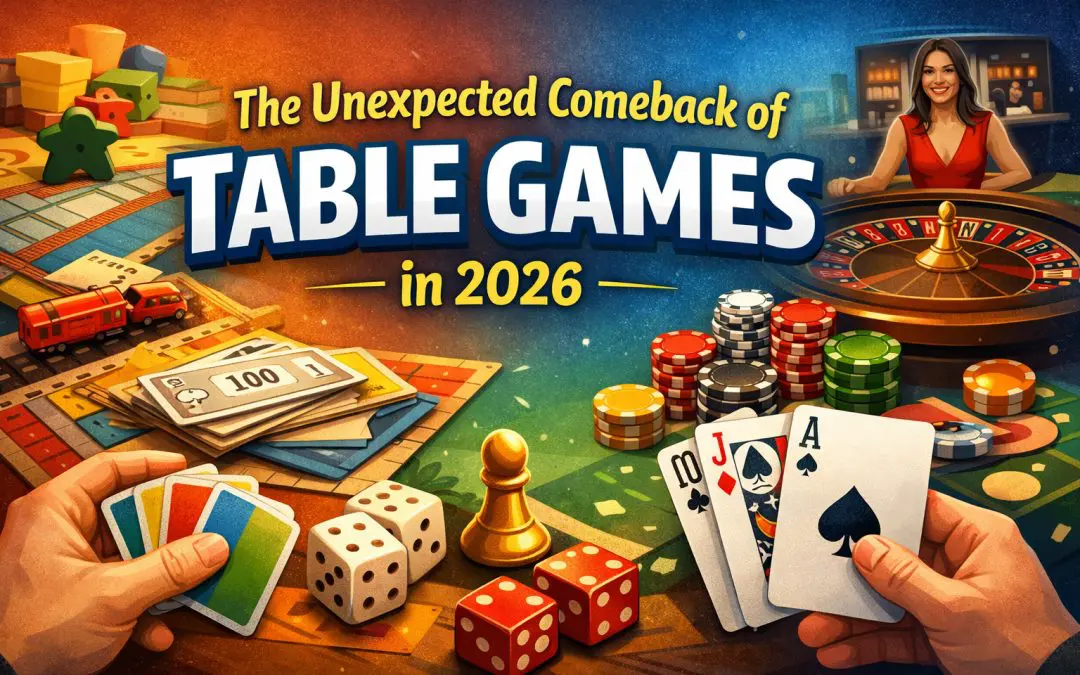
The return of tabletop games is significant — and it’s more than just a reaction against modern digital entertainment.
Tabletop games are making a comeback today in ways that go far beyond nostalgia. Nostalgia certainly played a role — it’s likely responsible for the initial interest in classic board games. The “pandemic bump” probably helped too — the pandemic introduced a whole new generation of gamers to board games.
However, the overall growth of the board game market has leveled off since the pandemic ended. In fact, according to ICv2, the hobby game market in North America was stable at approximately $2.84 billion dollars in 2024, essentially equivalent to 2023 numbers and 70% higher than pre-pandemic numbers.
So while people are still interested in buying board games, they’re not necessarily buying them because they’re nostalgic for a particular type of experience. Instead, people seem to be increasingly seeking out experiences that allow them to interact socially with others in ways that aren’t possible digitally. That may include activities that take place in-person, but it doesn’t necessarily involve going to a bar or watching a sporting event.
When people think about why board games are suddenly popular again, they tend to focus on either nostalgia or the pandemic. While both factors contributed to the recent resurgence in popularity of board games, neither factor explains why the hobby has continued to grow and remain popular.
One key difference between the reasons we typically hear cited for the resurgence of board games, and the real explanation, is the concept of shared attention. Digital entertainment is designed to provide consumers with endless options and personalized content. However, this personalization is ultimately isolating and prevents people from experiencing moments of collective attention with others.
For instance, when someone watches a movie or plays video games, they are generally alone. Even when they watch movies with others, those experiences are often passive and don’t foster opportunities for interaction and engagement. Tabletop games offer an alternative form of social interaction. They encourage shared attention and social interaction among participants. This is particularly true when compared to forms of digital entertainment.
Moreover, as screens continue to advance and become more sophisticated, the potential for engaging in digital experiences increases. At the same time, however, the ability of humans to engage with one another through screens continues to decrease. The result is that people are increasingly drawn to experiences that facilitate shared attention and social connection. That is precisely why people are gravitating toward tabletop games and other forms of analog entertainment.
Another major contributor to the resurgence of board games is improved design. Many contemporary tabletop strategy games are more enjoyable than traditional board games. Not only are newer games more visually appealing than earlier versions of board games, they are also better-paced, more user-friendly, and more intentional about creating fun experiences for players.
A great example of this can be seen in Ticket to Ride. One of the primary advantages of Ticket to Ride is that it provides relatively rapid decision-making options for new players. Therefore, it serves as a gateway to help players transition into more complex and challenging board games. Because it offers a clear understanding of how gameplay will evolve throughout the duration of a match, it is easily taught to new players. As a result, Ticket to Ride remains one of the most widely used entry-level games for introducing people to tabletop gaming.
Additionally, many modern tabletop strategy games were designed with cooperative play in mind. Cooperative games emphasize teamwork among players; whereas competitive games feature individuals competing against one another. One notable example of a successful cooperative game is Pandemic. It demonstrated several years ago that cooperative tension can be equally entertaining as competitive tension.
Because Pandemic offered a unique opportunity for players to work together and achieve goals cooperatively — and because it provided multiple challenges for players to overcome — it served as a model for cooperative tabletop strategies. Consequently, it made the transition to more complex and difficult tabletop strategy games significantly easier for players who previously had limited experience playing board games competitively.
Beyond that, the practical nature of tabletop games makes them attractive to adults. Unlike movies or nights out, tabletop games do not require people to spend money or travel long distances. Additionally, unlike video games that frequently require similar skill sets among all players, tabletop games can accommodate varying levels of expertise. Finally, while video games often demand constant updates to equipment and software — and often require people to stare at additional screens — tabletop games only ask players for space on a table, time to devote to gameplay, and a willingness to participate in a shared experience.
As a result, the trade-offs associated with participating in tabletop gaming have proven attractive to many adults. They enjoy structured social interactions that do not rely on drinking or viewing television broadcasts related to sports. Thus, they find themselves moving towards more frequent participation in tabletop gaming events.
In addition to providing social benefits and improving design, another reason that tabletop gaming has experienced renewed interest is due to advances in live casino technology. Live casino technology allows for greater social interaction than virtual casinos — players can interact with dealers and other players in real-time via streaming services.
According to a report released by Evolution Gaming in early 2025, live casino revenue reached €438.6 million in Q4 2024 — although this represents a decline from last year’s results in this area. Nonetheless, as Evolution noted in its report, live casino revenue remains robust, reflecting ongoing consumer interest in live gaming experiences.
As mentioned above, one of the greatest attractions of live dealer games is that they offer more of an experience than digital alternatives. Blackjack and roulette appear to be alive when a player is able to view a dealer in action and observe other elements of the experience unfolding in real-time.
Therefore, it is not surprising that consumers are continuing to opt for live dealer games over auto-played digital table simulations — despite the latter being faster and cheaper. Consumers are willing to pay extra for a more authentic experience — whether they realize it or not.
Ultimately, the experience of playing table games has evolved in response to changing societal trends and technological advancements. What consumers now look for in their gaming experiences has changed dramatically over the past decade.
Historically, consumers primarily looked at table games as vehicles for obtaining specific outcomes — i.e., winning money or beating opponents. Today, however, consumers are increasingly attracted to table games because they can evoke feelings of community and social bonding — i.e., as vehicles for evoking emotions related to social interaction and camaraderie.
As discussed below, this cultural evolution has resulted in changes in consumer preferences regarding table games — and has led to the emergence of new types of table game products.
Examples of table game products that embody these changing consumer preferences include: Heat: Pedal to the Metal; Planet Unknown; Gold Country; etc… These types of products reflect evolving attitudes toward the importance of social interaction and emotional engagement within gaming experiences.
The most obvious examples of these emerging product categories are Heat: Pedal to the Metal and Planet Unknown.
Heat: Pedal to the Metal has emerged as perhaps the most representative example of this trend — specifically because it appeals to a wide range of consumers regardless of age or skill level.
While it certainly appeals to younger consumers who are eager for fast-paced competitions with high stakes — Heat: Pedal to the Metal also appeals to older consumers who are looking for slower-paced experiences with lower stakes.
Unlike video games that appeal largely to younger consumers — Heat: Pedal to the Metal appeals to a broad base of consumers including young adults and older adults alike.
It accomplishes this by using hand-management mechanics (such as managing heat) as opposed to relying solely on luck-based mechanisms (such as spinning wheels). It thus creates a rich and immersive experience that rewards repeated play and promotes long-term engagement.
Similarly, Planet Unknown embodies these changing attitudes toward gaming experiences by incorporating innovative mechanisms such as polyomino placement and engine building into its gameplay structure.
By employing these advanced mechanics — Planet Unknown appeals to consumers who desire more complexity and challenge within their gaming experiences.
As such — Planet Unknown embodies many of the evolving attitudes toward gaming experiences discussed above by creating an immersive experience that rewards repeated play and promotes long-term engagement.
Finally, Ticket To Ride is another example of this emerging trend within table games.
Ticket To Ride initially emerged as a highly successful product by emphasizing simplicity and ease-of-use within its gameplay structure — thereby serving as a gateway product for introducing new consumers into tabletop gaming.
Over time — however — Ticket To Ride has evolved into a more complex product that appeals to consumers who desire more variety within their gaming experiences.
Specifically — Ticket To Ride features a number of expansions that add new gameplay structures — such as additional countries or train cars — allowing players to explore various aspects of geography or transportation engineering within their gameplay experience.
Thus — Ticket To Ride represents an evolution toward more complexity and variety within tabletop gaming products.
With regard to future trends in tabletop gaming — one trend that emerges clearly is increased emphasis on innovation and experimentation.
As consumers increasingly seek out novel and exciting experiences within tabletop gaming — manufacturers are responding by developing new and imaginative products.
Gold Country represents an example of this trend by combining speculative mechanics with an educational theme centered around California’s gold rush history.
Furthermore — as discussed above — manufacturers are increasingly recognizing that the value proposition for tabletop gaming extends beyond merely providing individual entertainment experiences.
Crowdfunding has altered what popular means
Kickstarter has impacted the economic environment and the culture of tabletop games in ways that are difficult to understand if you just focus on what is available in stores.
Tabletop games represented 83% of all games pledge categories on Kickstarter in 2024. According to the site, there were 6,646 tabletop game projects posted, 5,314 successfully funded, an 80% success rate, and $220 million pledged to successful tabletop campaigns. These aren’t side hustles; these are established parallel pipelines for discovery, marketing, and building communities. (updates.Kickstarter.com)
This has had both positive and negative effects.
On the plus side, it has opened up the space for more themes, more designers, and more players to feel invested due to their involvement in the process of a game from prototype to production.
However, it has also resulted in a mass release of products and an attention-based economy that can bury great games in a sea of deluxe plastics and marketing hype. As icv2 stated, 2024 saw many publishers struggling to find their place among a multitude of releases and smaller box sizes. This sounds true. The marketplace has become better than it was during the old monoculture Days; however, it’s also noisier.
Regardless, the ability of crowdfunding to create a constant flow of products and allow the enthusiasm for a product to build prior to its release is one of the key reasons the board games’ renaissance has a sustainable future.
Crowdfunding provides a constantly changing pipeline, allows the enthusiasm to build prior to release, and gives the hobbyist a sense of participation versus simply accepting top-down direction.
Why classic casino games are back too
The unanticipated aspect of this entire story is that the analog games renaissance isn’t limited to hobbyist shelves and dining tables. It also includes casino play.
Blackjack and Roulette didn’t disappear completely. However, they were overshadowed by Digital versions for years due to speed, noise level and automation. What changed was how the presentations were done. Live dealer tables provided the classic casino experience with the rhythm of live play. The pause between hands, the slow spinning of a Roulette wheel — this type of suspense occurs differently when physically observable as opposed to as instant animated action. Even those players who prefer Digital convenience will likely want the social theatre of playing in person.
That matters because the classic casino experience relies heavily on atmosphere/mood as well as mechanics. Blackjack benefits greatly from providing an illusion of control — that rewarding feeling that decisions count despite knowing there is a built-in advantage to the house. Roulette is primarily based upon spectacular visuals. When you remove either element from a mechanical standpoint, some of the appeal diminishes. Add back people doing things slowly enough so they can appear human, add back latency so players don’t feel like they’re watching a video and provide a way for the game to feel like it’s occurring in a room — all of a sudden classic casino formulas seem new again.
Here is another interesting parallel between modern board games and table games: both are benefiting from a larger cultural movement towards experiences that feel boundaried, bodily and communal. Everything doesn’t need to be optimized to death. Sometimes it’s the friction itself that’s enjoyable.
Digital didn’t kill table games. It prepared their next audience
one of the main reasons that this recent social table games resurgence has caught some commentors off guard is that they continue to view analog and Digital as opposing forces. In reality, they frequently complement each other.
A prime example of this relationship is board game arena. Many players currently learn new games via online platforms, determine if they’ll enjoy them, and subsequently purchase a physical copy for use in local gaming sessions. This ‘Digital ramp’ is particularly useful for games with extensive rule sets — when players experience their first exposure to a more complex game via an online platform utilizing auto-scoring and turn management — the physical copy becomes significantly less daunting for subsequent plays. (board game arena)
The same dynamic exists in casino environments through the implementation of live dealer technology. Technology did not eliminate table games; it merely made them more accessible. It allowed customers to participate in Blackjack or Roulette using mobile devices/laptops while maintaining sufficient elements of the original experience to preserve the identity of the respective genres. Although live casino performance has declined somewhat for a major operator such as Evolution gaming — the overall size of the category indicates that format-based table games still represent a significant portion of the larger gaming ecosystem. (Evolution)
Therefore, although the question “why are board games coming back?” Seems simple enough, it’s actually quite complex. one piece of evidence supporting this assertion is ironic in nature: Digital technologies have helped promote many of today’s popular board games by introducing players, lowering entry costs, reminding participants of what they enjoyed about competitive/structured play — and allowing them to rediscover this enjoyment at a physical table.
What 2026 will look like from the table
To summarize: players are moving toward games that offer a social component, are educational/training oriented and produce repeated interest.
Not necessarily simpler; just cleaner.
That is why strategy games are receiving increasing attention as are expansions such as Heat: Legends. The expansion converts additional cars into automated legend drivers with adjustable difficulty, thereby addressing an issue that appeals strongly to today’s gamers — flexibility in gameplay options, strong solo support and scalable group play without impacting game integrity. (Days of Wonder: play different.)
Additionally, publishers are beginning to develop more comprehensive plans regarding table presence/session length/onboarding. While a visually appealing game that requires 60 minutes of explanation will struggle against competition — a cleverly designed game that produces a memorable table experience within 15 minutes has a higher likelihood of becoming someone’s go-to reference.
Finally, there is growing acceptance of the possibility that multiple types of table-based experiences can exist simultaneously. For instance, a family may maintain Monopoly for nostalgic purposes, Ticket to ride for weeknight gaming sessions, pandemic for cooperative tension — and a longer/heavier title for Saturday gaming sessions alone. Having this variety is beneficial — it demonstrates that the current board gaming revival will not be driven solely by a singular sub-culture.
Where do we go from here?
I believe that table games are experiencing a sustained resurgence — rather than an isolated retro-moment. Additionally, i believe they will assume a continued position as a counterpoint to the remainder of entertainment.
That does not suggest all signals are perfectly aligned. There is overcrowding at retail locations. There is fragmentation of attention. Crowdfunding creates exaggerated expectations. Too many games are produced overabundantly and under-developed — and not every family game night is an idyllic unplug experience — sometimes someone is exhausted; one player dislikes head-to-head conflict — and sometimes the rules explanation feels similar to attending a seminar on taxes.
But perhaps nothing illustrates this revival as clearly as the fact that table games are returning to common usage levels — table games are no longer viewed as novelty items — table games are becoming woven into daily life with all of its inherent messiness.
Perhaps the most telling number throughout this entire narrative may not be individual title sales figures or trends lists from board game geek; rather, it could be that after the post-pandemic surge leveled out — the hobby market remained high — while crowdfunded tabletop projects continue to raise hundreds of millions annually — and Digital platforms continue to grow the pool that ultimately feeds physical play — these statistics demonstrate that we are looking at a segment that has evolved beyond a fad. (icv2)
Thusly; yes, the return of classic table games is real; yes, the resurgence of board games is real; and yes; the revival of classic casino games is also real; but each in their own way — and the reason behind them is not mysterious once you sit at the table long enough.
People still want to gather around a shared set of rules and see what happens.
Perhaps now more than ever