
Fortunium Gold lives in that slightly awkward but interesting space where two very different player mindsets collide. On one side, you have the spreadsheet people who care about RTP decimals and long-term loss curves. On the other, you have jackpot hunters who just want that wheel to show up once and change everything. Fortunium Gold does not fully belong to either camp, which is probably why it keeps getting talked about.
After enough sessions, you start to feel its personality. Not in a mystical way, but in a “okay, I know how you behave now” way. The numbers stop being abstract, and the rhythm of the game becomes familiar. That is where this deep dive really starts to make sense.
Fortunium Gold often gets described as a Mega Moolah-style slot, and honestly, that comparison is doing a lot of heavy lifting. The progressive structure, the jackpot ladder, the anticipation when the wheel animation kicks in, it all traces back to Mega Moolah. If you have ever sat through a Mega Moolah session watching your balance slowly drip while waiting for something dramatic to happen, the feeling here will be familiar.
What feels different is the pacing. Fortunium Gold does not leave you staring at dead spins for long stretches. Even on a mediocre session, you tend to get little nudges from the reels. Small line wins, occasional symbol stacks, just enough movement to stop you from checking your phone every five spins. That is not generosity. That is design.
Visually, the steampunk theme does its job without screaming for attention. Gears, brass tones, mechanical flourishes. It feels confident rather than flashy, which oddly mirrors how the math behaves underneath.
Core stats: RTP, volatility, and hit rate
Before getting carried away with vibes and impressions, the hard numbers deserve a proper look, because they explain almost everything that happens later.
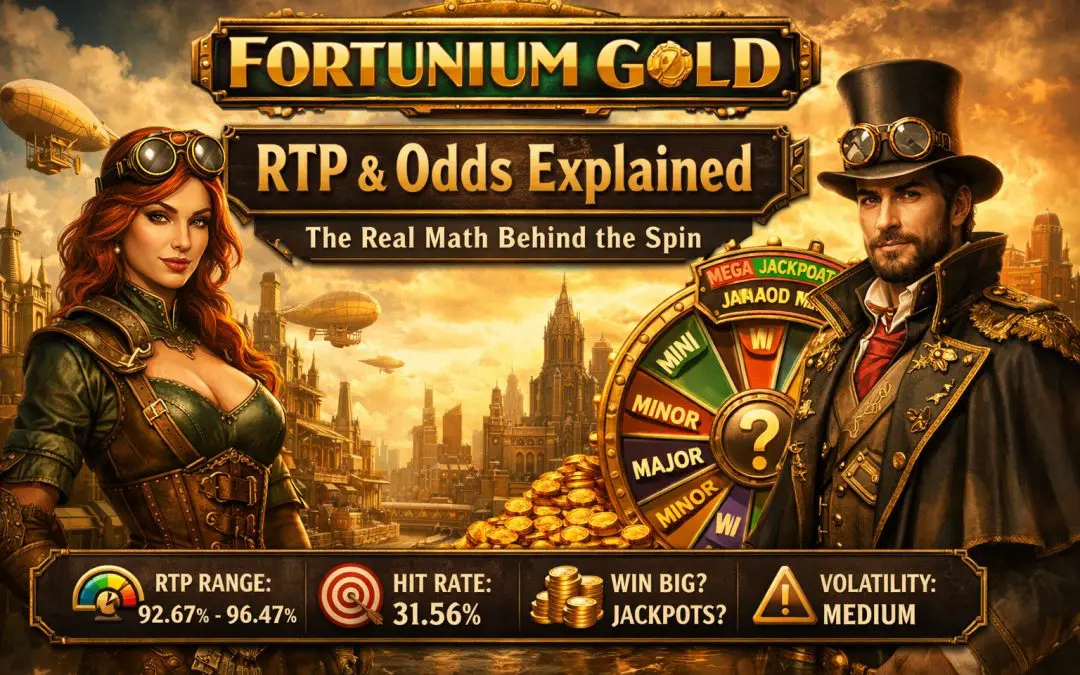
Fortunium Gold runs on multiple RTP configurations. Depending on the casino, the theoretical return to player usually sits somewhere between 92.67 percent and 96.47 percent. That gap is not trivial. It is the difference between a session that feels survivable and one that quietly eats your bankroll faster than expected.
Volatility is classed as medium, and that feels accurate in real play. You are not stuck in endless droughts, but you are also not popping off constant big wins. Most sessions settle into a steady pattern with occasional spikes that wake you up a bit.
The hit rate clocks in at about 31.56 percent. Roughly one in three spins pays something. Not necessarily profit, not even close sometimes, but something. That stat is doing a lot of psychological work behind the scenes.
Fortunium Gold RTP ranges explained
That RTP range from 92.67 percent to 96.47 percent is where many players unknowingly trip themselves up. On paper, both numbers belong to the same game. In practice, they behave very differently.
At the top end, the house edge drops to around 3.53 percent. At the lower end, you are staring at something north of 7 percent. Over a handful of spins, you will not notice. Over hundreds or thousands, it becomes impossible to ignore.
I have had sessions where Fortunium Gold felt almost polite. Losses came slowly, wins recycled balance, and it felt like the game was giving me time to think. I have also had sessions where it felt impatient, like it wanted the session over with. Same slot. Different RTP setting.
Once you realize that, a lot of forum arguments suddenly make sense.
How casino RTP settings affect play
Casinos choose which RTP version they run. Players do not get a pop-up asking for permission. That is just how modern slots work.
The effect shows up in subtle ways. Lower RTP versions tend to shorten sessions. You hit fewer stretches where small wins cushion the balance. Recovery after a bad run feels harder. The game still looks the same, but it feels less forgiving.
Higher RTP versions give you more breathing room. You still lose in the long run, but the path there feels smoother. For players who like to settle in and play for a while, that difference matters.
If someone tells you Fortunium Gold is “tight” or “loose,” there is a good chance they are both right and just playing in different places.
Base game RTP versus jackpot contribution
Here is where things get quietly expensive. Around 5.3 percent of the total RTP is allocated to the progressive jackpots. That contribution is invisible during normal play, but it is always there, quietly siphoning value out of the base game.
The headline RTP includes the jackpots. Strip them away, and the underlying reel game returns noticeably less. That explains why base game wins often feel conservative, even when things are going well.
This is the classic progressive slot trade-off. You give up some regular payout potential for a very slim chance at something massive. Some players love that idea. Others hate it once they really think about it.
Neither reaction is wrong. It just depends on what you are actually playing for.
Calculating house edge and expected spins
House edge sounds abstract until you put it into session terms. If the RTP is 96.47 percent, the house edge is 3.53 percent. That is the long-term cost of spinning.
Imagine wagering 100 credits per spin for 1,000 spins. That is 100,000 credits cycled through the game. At a 3.53 percent edge, the expected loss is about 3,530 credits. At a 7.33 percent edge, it jumps past 7,300 credits.
That does not mean you will lose exactly that amount. Anyone who has played slots knows sessions can swing wildly. It does mean that over time, the math gently but persistently pulls results back toward those numbers.
This is why RTP awareness stops being optional once you play regularly.
Paylines, bets, and win probability
Fortunium Gold uses 40 fixed paylines. You cannot turn them on or off, which simplifies things and keeps win probability consistent across bet sizes.
Changing your bet does not change RTP, but it absolutely changes how volatility feels. Higher bets magnify swings. Lower bets stretch sessions and soften the emotional impact of losing streaks.
Symbol distribution does most of the work here. Low-value symbols land often and keep the hit rate healthy. High-value symbols show up less frequently and tend to matter most during features or stacked reel moments.
It is a carefully tuned balance, and you can feel it once you pay attention.
Hit rate and payout frequency explained
A hit rate of 31.56 percent sounds generous until you remember that many hits are small. Still, that frequency shapes the entire experience.
You are rarely left staring at empty spins for long. Even when the balance is trending down, little wins interrupt the slide. That keeps players engaged, sometimes longer than they planned.
I have had sessions where I knew I was slowly losing, but the steady trickle of minor wins made it feel manageable. That is not luck. That is design psychology doing its thing.
Free spins, multipliers, and bonus buy RTP
Free spins are where Fortunium Gold briefly changes tone. Multipliers stack, reels feel heavier, and the win potential becomes more obvious.
From a math perspective, free spins do not magically improve RTP. They redistribute value into short, high-impact moments. When they hit, they hit hard. When they do not, the session quickly snaps back to normal.
Bonus buy options, when available, compress variance even further. You skip the buildup and jump straight into the most volatile part of the game. Some players love the clarity of that. Others miss the anticipation.
Personally, bonus buys feel like fast-forwarding a song you actually enjoy listening to. Efficient, but less satisfying.
Jackpot wheel odds and triggers
The jackpot wheel is the emotional centerpiece of Fortunium Gold. Everything else exists to support that moment.
It does not trigger often. Many sessions will never see it. When it does appear, the odds heavily favor the smaller jackpots. The Mega is the longest shot by far, which is exactly why it can grow so large.
That tension is the whole point. The wheel keeps hope alive, even when logic says the odds are brutal. Players know this, but they spin anyway.
Slots have always been good at that.
Checking real RTP in casinos
This is one of those unglamorous habits that actually pays off over time.
- Open the game and access the information or help panel.
- Look for RTP, payout percentage, or version details.
- Compare the listed RTP with known Fortunium Gold ranges.
- Check the casino’s general RTP disclosure if the game itself is vague.
- When nothing is clear, assume the lower RTP and adjust expectations.
It takes about a minute and saves a lot of frustration later.
Strategies for medium volatility play
No strategy changes the math, but you can absolutely play in ways that fit the slot better.
Fortunium Gold rewards patience more than aggression. Short, high-stakes bursts tend to exaggerate losses. Longer sessions with controlled bets give the hit rate time to do its cushioning work.
Setting a session limit matters more here than chasing wins. When the game heats up, it often pays in clusters. When it cools down, it bleeds slowly. Recognizing which phase you are in is half the battle.
Fortunium Gold is not dramatic most of the time. It is steady, occasionally surprising, and quietly expensive if you ignore the numbers.
That combination is exactly why it keeps pulling players back.