
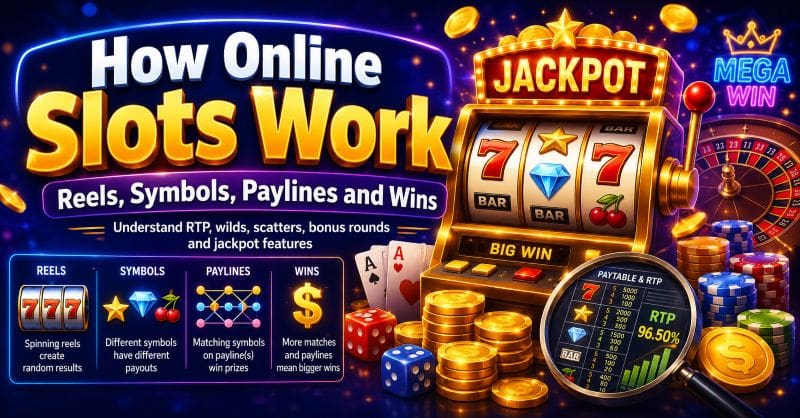
The main elements of how slot games operate include reels and symbols. When you remove the visual effects and animations, every slot game uses a grid. The basic layout of a 3 reel game, with the three vertical columns and the 15-25 symbols cycling through each column, is essentially the digital equivalent of the mechanical fruit machines from previous generations. Video Slots with 5 or more reels expanded that grid significantly, and often ran four or five rows deep, thus multiplying the number of possible symbol combinations on-screen simultaneously. Thus, a slot may have a seemingly generous appearance with numerous symbols flashing on-screen constantly yet be using a relatively low RTP.
Symbols can be categorized in a couple of primary ways. Symbols that represent standard characters or objects pay according to the pay table when enough of them appear in a combination. Wild symbols substitute for other symbols to form combinations and function somewhat like a joker card. Scatter symbols often pay regardless of their location on the grid, and frequently trigger special bonuses when a specified number appear. Some slot games feature specialized Bonus symbols intended solely to initiate separate minigames.
Understanding how Paylines in online Slots work
Paylines refer to the way in which winnings are paid for in a slot. The method used to determine winnings in a slot involves determining if there is a predetermined sequence of symbols that appear consecutively along specific paths on the reels. To qualify as a winner, the Player must ensure that a predetermined sequence of symbols appears on one of these lines. Static Paylines are always activated and never change. Dynamic Paylines allow players to select how many lines to activate prior to making a spin. The number of possible Paylines varies greatly among various Slots. three reel games frequently contain only one payline running horizontally across the center of the reels. Five reel games can offer anything from 10 to hundreds of possible Paylines. The most recent trend within online Slots includes using dynamic Paylines, referred to as “ways to win”, which offers players thousands of possible combinations for generating wins. Rather than requiring players to match a static sequence of symbols along a predefined path, “ways to win” Slots award players for any time a group of consecutive reels contain the same symbol. Cluster pays and grid Slots abandon the traditional use of reels altogether. In these types of Slots, awards occur based upon any occurrence of a minimum number (usually five) of consecutive identical symbols appearing anywhere on the grid. Many of these games utilize a “tumble” feature, wherein winning symbols disappear and new symbols fall into their places, allowing players to potentially create additional winning combinations from a single spin. Here is a comparison chart showing the differences between some of these variations:
- Fixed Paylines: set patterns that players must align; bet per line; must align exact pattern
- Adjustable Paylines: same mechanic, however players can choose how many lines are active
- Ways to win: adjacent reel matches count regardless of row; typically 243-1,000+ ways
- Cluster pays: consecutive occurrences of identical symbols anywhere on the grid; does not require reels
- Scatter pays: certain symbols award from any position on screen; regardless of lines or clusters
Calculating slot wins
Each legitimate slot publishes a pay table and understanding that before starting play is the best investment of five minutes you can make on any new title. The process for calculating pay tables and slot wins is accomplished by establishing a payout multiplier for each symbol based upon the number of times it occurs in a combination. For example, say you find four-of-a-kind with an 8x multiplier for the particular symbol. If you are betting $0.25/line, the four-of-a-kind will net you $2.00 on that single line. If you manage to get a combination of symbols lined up so that several pay lines are active, the payouts stack and add together, creating potential payouts larger than would be indicated by looking at any one line in isolation. Wild symbols typically resolve to either create the highest possible combination available or substitute for the combination that would result in the greatest payout. Scatter wins are typically calculated against your overall bet rather than against your bet-per-line, due to their ability to trigger from any position on the screen and not being dependent upon landing on any particular line. Hit frequency in Slots refers to the rate at which a given spin produces any type of win. High hit frequencies produce frequent small wins, which creates an illusion that the game is more active than it truly is.

Random vs rigged Slots
Slot games run on random number generators (RNG), which generate random numbers continuously whether a Player is active or inactive. Each time a Player initiates a spin, the RNG generates a random number corresponding to a specific outcome for each reel. No warm-up period exists, nor does any pattern develop that leads to increased payouts at some point down the road. Each spin is completely independent of all others in terms of mathematical probability. Independent third-party laboratories such as eCogra and GLI test both RNG’s and underlying mathematical models prior to releasing a game into public circulation and verify that RTP values published by providers are accurate and cannot be altered after release.
Understanding slot volatility
Return to Player (RTP) defined: it is a theoretically determined percentage based upon millions of simulated spins — not guaranteed to happen during your next hour of play. A game advertised as having 96.5% RTP is statistically designed to return approximately 96.5 cents out of every dollar invested in it across its lifetime by all players who have played it. Any losses you incur during a session, including losing your entire bankroll, are perfectly acceptable within this statistical framework. Volatility levels do not imply better or worse options — they provide you with information necessary to choose games that are compatible with your bankroll size and your patience level.
Bonus rounds, wilds and progressive jackpot Slots
Free spins are probably the most common Bonus round type found today and typically occur when a sufficient number of Scatter symbols appear in combination with one another and allow you to continue playing without spending your own money. Within Bonus modes, wild symbols and Scatter symbols often act differently than they do in the base game. Therefore, it is advisable to review your game’s help screen prior to assuming that rules apply consistently throughout.
Progressive jackpot Slots use a pooled approach, meaning a fraction of every bet made on a series of connected machines (sometimes across multiple casinos utilizing the same software provider) contributes to the progressive jackpot which grows continuously until someone achieves the winning combination. While progressive jackpot amounts can reach anywhere from tens of thousands into the millions depending on the largest networked titles utilized today, typically the cost is paid via lowering the rtp for play outside of the progressive jackpot portion. Recognizing features such as those discussed above influences how you perceive math associated with sessions and should be taken seriously.
Pre-spin checklist
While nothing is going to affect the final outcome of any individual spin and RNG does not take into consideration what you know, performing a brief pre-spin check will improve your selection criteria for which platforms you wish to play on. Make sure that an official RTP is listed somewhere in your game’s info screen and preferably at 96% or greater, when choosing between similar products. Take note of what type of payline structure is employed (fixed-payline, ways-to-win, or Cluster-style) since it will influence how regularly you observe activity occurring in-game.
See if your developer lists an officially recognized volatility level (low-medium-high). Review what event(s) will trigger Bonus mode and if wilds perform differently during Bonus mode than they did during base play. Finally, confirm that your developers’ platform utilizes an independently tested laboratory (e.g., ecogra/GLI) instead of merely stating “certified fair” with no evidence provided.
Slots are meant to seem magical at face value and are designed that way — but beneath the lights, reels/symbols/Paylines/RNG’s perform exactly as prescribed by math model, one spin after another. .
Simplifying what needs to be understood about how slot games operate
Slots operate primarily around two components: reels and symbols. Once you strip away all visuals and animation, all Slots use grids. Classic 3-reel slots were created directly digitally from mechanical fruit machines of last generation. Video Slots with 5+ reels dramatically expand this grid into four or five rows deep which multiply possible symbol combinations at any moment on-screen simultaneously. This is why a slot can look very liberal with symbols flashing across the screen continually even when operating with moderate RTP.
Standard symbols pay according to the pay table when they appear sufficiently in combination. Wilds replace other symbols to complete combinations and function similarly to joker cards in poker-style games. Scatters usually pay regardless of their location on the grid and often start Bonus rounds when enough of them show up at any spot.
Some games feature Bonus symbols specifically for activating separate mini-games.
Static Paylines follow established paths on reels and are always active. Dynamic Paylines are selected by players before they spin and allow players to choose how many lines are active at any time.
There are countless possibilities for how many Paylines exist in Slots as well as how Paylines are structured between different types of Slots. Some 3 reel games offer only 1 payline running straight across the center of the reels while some 5 reel games offer upwards of 100 possible Paylines.
In addition to traditional methods for forming winning combinations some modern Slots have started employing dynamic payline structures that award players for achieving consecutive reels containing the same symbol regardless of what row it occupies. Examples include “ways-to-win” Slots which offer thousands of possible combinations for achieving wins. Cluster pays and grid Slots eliminate traditional concepts related to reels and award winners based upon clusters or groups of consecutive identical symbols appearing anywhere on the grid.
Many Cluster pays and grid Slots utilize tumble systems that award additional prizes when winning combinations cause previously winning symbols to disappear and new symbols drop down into their space thereby offering opportunities for secondary wins based upon the initial spin.
Comparison chart
- Fixed lines: predefined paths that must be matched exactly; bet per line
- Dynamic lines: same mechanics as above however players can choose which paths are active prior to spinning
- Ways to win: matches between consecutive reels will award regardless of row occupied; typically offered at 243+, etc.
- Cluster pays: any number of identical symbols touching in groups on the grid will award; does not involve reels traditionally
- Scatter pays: specific symbols will award from any position on the screen regardless of whether or not they match established patterns
Determining slot winnings
All legitimate slot releases publish a pay table and reviewing said table before beginning play provides perhaps the most valuable five minutes you could invest on any new title.
Calculating slot winnings is achieved by assigning each symbol a payout multiplier based upon how many times it appears in a combination. For example, let’s say we find four-of-a-kind with an eight x multiplier assigned to that symbol; if our bet-per-line is .25 then four-of-a-kind will yield us $2.00 on that one line alone. Should multiple Paylines combine on one spin the payouts stack and add together creating possible payouts far beyond those shown by evaluating any single line individually. Wilds typically resolve either by creating the most profitable combination available or by substituting for the combination that yields the most profit.
Scatter wins are typically awarded against your overall bet rather than your bet-per-line as scatters are capable of triggering from any position on screen and don’t rely upon matching established patterns.
Hit frequency in Slots
Hit frequency in Slots represents how often a spin results in some type of win regardless of magnitude. High hit frequency Slots result in an abundance of small wins resulting in a false impression regarding activity within gameplay.
Random vs rigged Slots
Online Slots operate using random number generators (RNG’s); RNG’s generate random numbers continuously whether a Player is engaged or not engaged in play.
When a Player presses spin, the RNG instantly assigns a random number representing an exact outcome for each reel. No build-up exists; no pattern emerges resulting in enhanced payouts at some future date; each spin operates independently with respect to mathematical probability.
Independent third-party labs such as ecogra/GLI evaluate both RNGs and mathematical models underlying slot games before releasing them into public circulation verifying that RTP values released by operators accurately reflect true statistical likelihoods, therefore eliminating possibility that operators can manipulate post-release RTP values.
Volatility levels in Slots
RTP = statistically determined percentage based upon millions of simulated spins — not guaranteed during your next hour of play! A slot advertised as 96.5% RTP is statistically designed to return approximately 96.5 cents for every dollar spent on it across its life span by all players who have interacted with it.
Any losses incurred during a session loss of all funds are totally permissible within statistical parameters outlined above.
Risk level/volatility is about matching your bankroll & patience to available games options not more or less intelligent option choices
Bonus Rounds/Wilds/Progressive Jackpots
Free spins — most common Bonus round type — usually triggered by landing sufficient numbers of Scatter symbols together allowing players to continue playing without spending own money.
Wild symbols & Scatter symbols often act differently than in base game throughout Bonus rounds — please verify your game’s help section before assuming rules remain consistent throughout.
Progressive jackpot Slots use pooled methodology — fraction of bets placed across network of connected machines feed continuous growth towards shared jackpot until combination achieving winner appears.
Examples include: tens of thousands into millions depending upon largest network titles used today; typically cost paid through lowering RTP outside of progressive jackpot component.
Recognizing features like those discussed influence perception of math associated with sessions and should be considered seriously
Pre-spin checklist
Nothing will alter ultimate outcome of individual spin; RNG does not consider your knowledge — briefly reviewing items below will enhance selection criteria for platforms you wish to play on.
Verify official RTP is listed somewhere in your game’s info screen — preferably >= 96% — when choosing similar products.
Note what type of payline structure is employed in your title (fixed-payline/ways-to-win/Cluster-stye).
Review developer-provided information regarding event(s) required to initiate Bonus mode and if wilds perform differently during Bonus mode compared to their performance in base play.
Finally, verify that the developer’s platform uses an independently tested laboratory (eg., ecogra/GLI) versus claiming “certified fair” without supporting documentation.